

Serving the world since 1888.
Mechanical lubrication pumps
We believe we are unique in our ability to supply lubrication systems in any configuration to match customers’ needs. Our unrivalled twin shaft concept provides a robust lubricator offering hugely reliable performance with long-life.
Each of our systems is designed to match precisely our customers’ requirements. These sometimes exacting standards have resulted in a portfolio of systems which are wide and varied. Wm Coulthard & Co. can offer a truly bespoke service if needed or on the other hand provide units that are somewhat standard, but without standard performance.
Lubricators may be manufactured in carbon or stainless steels and supplied with baseplates, additional oil reservoirs, and any associated framework.
Systems may be self-contained units with motor and gearbox mounted on their own baseplate, or they can be driven by the customers’ equipment with a wide variety of shaft positions and internal gearing.
There are two main operational methods used when providing lubrication:
Both methods can be designed to have automatic re-filling if needed to reduce the need for frequent intervention.
Delivery of the lubricant can be made to suit every customer, situation or environmental conditions. Delivery may be:
Each of these methods has pros and cons and we would be delighted to discuss the merits of both to ensure you have the best possible designed system for the task needed.
Any flow rate, however small or large, can be achieved utilising the appropriate pump size, gearing, manifolds, or valves. We offer 3 sizes of pump units with plungers being 3/16”, 1/4” and 5/16” diameters.
Wm Coulthard offer a variety of monitoring instruments and devices that can help provide remote operation and reduce manual checks, confidently knowing that the lubricant is being delivered timely and with the correct volumes.
All systems meet the recognised standards including API 618 and ATEX.
Spare parts are readily available, as too are an extensive range of ancillaries.
A full refurbishment service to as new condition is provided, with a rapid turnaround if required.
WMC lubricator pumps
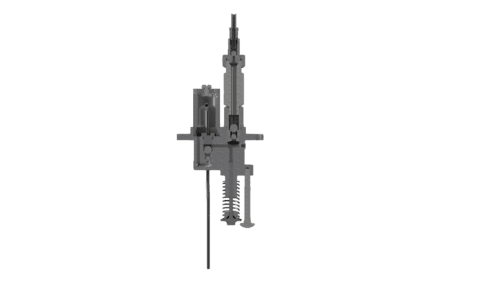
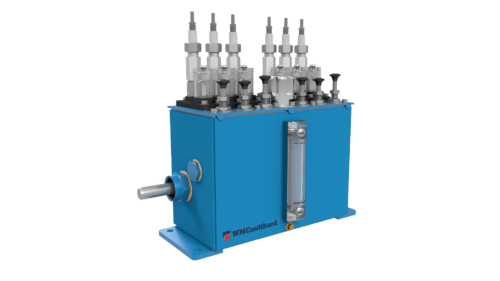
Universal lubricator pumps

Coulthard make lubricators, pumps and Lubrication systems conforming to to the API and En specifications.

Reseller partnerships available.
Speak to us for details.
Any questions?
A series of pumps inject oil from a reservoir at high pressure into the lubrication points on equipment.
The governing standard is API 618, which is generally accepted for non API 618 applications. In addition to this, we customise lubricators to customers’ individual needs.
The flow on each pump can be precisely adjustable to suit the needs of the equipment.
They are mainly used on reciprocating compressors and pumps, but have other applications in mining, food manufacturing, etc.
The minimum scope is a reservoir with a series of pumps internally mounted and driven directly or indirectly from a prime mover, e.g. a motor / gearbox assembly.
Although normally directly driven, we also manufacture lubricators with internal gearing to eliminate the need for an external gearbox, especially useful for being driven from a compressor shaft.
A single block or assembly delivers a fixed amount of oil at high pressure from a single supply source.
These are referenced in API 618, but extensively used in other industries, e.g. mining
Cost – a divider block is less expensive than a box lubricator, though it doesn’t have the capability to adjust individual flows, as it will upset the calculated balance between the outlets.
In addition to being an alternative to box lubricators, they are used for fixed lubrication on vehicles and other industrial applications.
In addition to the divider block, they can be supplied with a main feed and supply tank, relief valves, proximity switches and cycle indicators.
They can be supplied as a fixed block or modular design.
The system recirculates oil from the rotating equipment train bearings, cleaning it, cooling it and at the correct pressure.
The main applicable standard in the oil and gas industry is API 614 / EN10438, with other codes applicable for other services, e.g. boiler feed pump service.
Whilst comparatively expensive, using the correct components, they offer a safe, reliable supply of oil which is recirculated, so oil loss is minimal.
They are extensively used in the oil and gas industry for high-energy, rotating equipment trains.
An oil reservoir large enough to minimise entrained air, main and standby pumps, flow and pressure control, cooling, filtration and monitoring instrumentation for alarm and trip signalling.
There are three main varieties, manufacturer’s standard for commercial, API 614 general purpose for spared applications and API 614 special purpose for critical applications.
A single pump injects oil from a small tank or supply at high pressure into a lubrication point on equipment.
No international standards apply, but customer requirements will always be considered when specifying them.
They are a cheap, simple solution when a box lubricator or divider block installation is not necessary. However, they are not governed by any particular standard.
They are used extensively across multiple industries where a constant high pressure lubrication feed is required.
A simple, all in one package with a variable speed pump and motor assembled to a supply tank.
There are multiple variations, but usually is size.
